
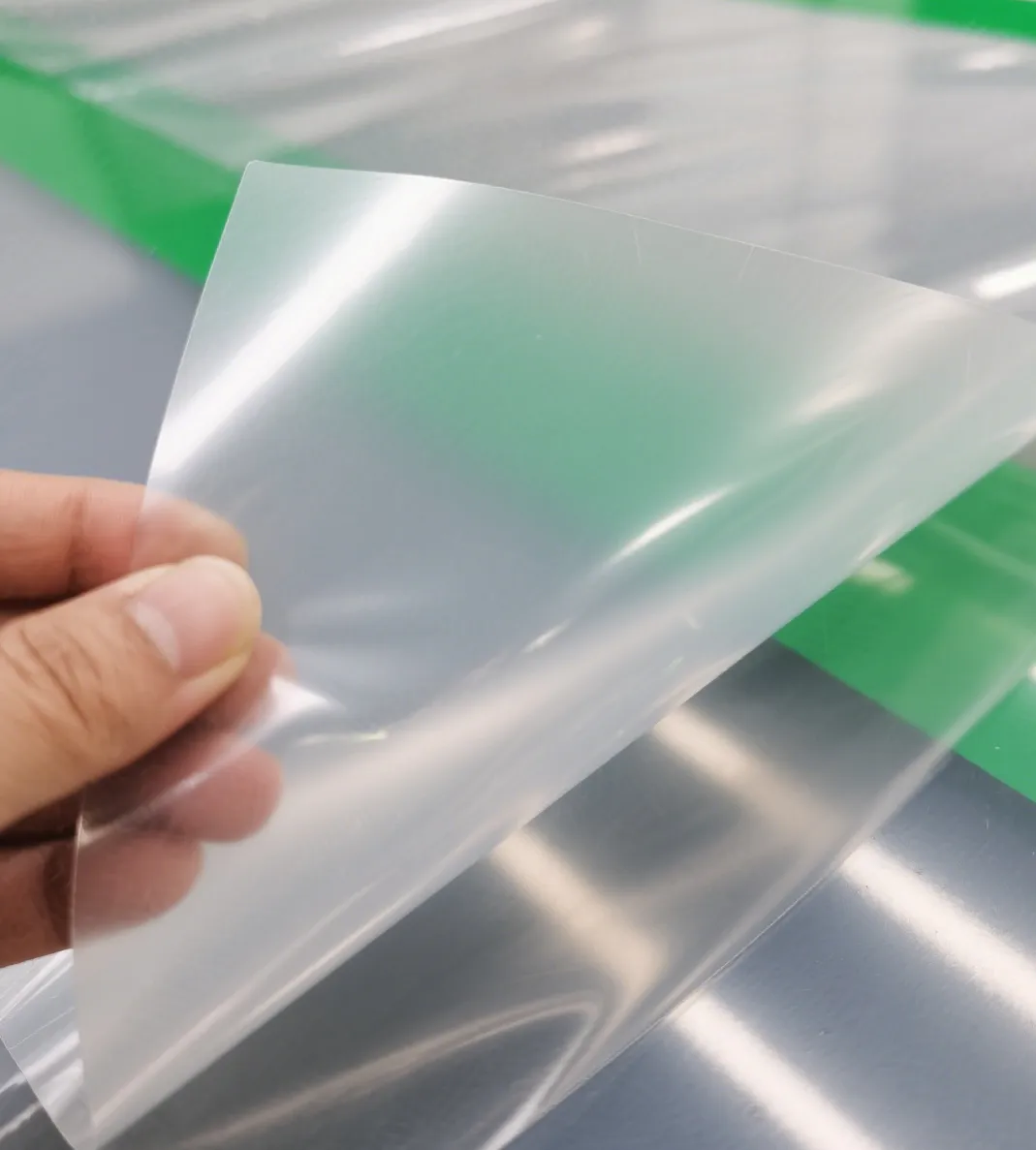
TPU Film Lamination to Fabric Without Delamination or Boardy Hand Feel
Grade Choice, Process Window and Bond Testing for Textile Laminates
TPU film lamination to fabric succeeds or fails on two variables that are set long before the machine runs: the grade of film and the surface energy of the textile. A bond that peels usually traces back to one of those, not to the laminator operator.
Boardy hand feel is a separate problem with a separate cause, and it is the one that gets a laminate rejected by a brand even when the bond is strong.
This article covers why TPU film lamination to fabric fails at the interface, how to choose a grade for the fibre in question, the process window that holds in production, and the tests that predict whether a laminate survives a wash cycle.
Why Laminates Peel at the Interface
Peel failure almost always starts with poor wetting. The adhesive or the softened film has to flow into the fibre bundle and around individual filaments, and it cannot do that if the surface energy is too low or the fibre is contaminated.
Finishes, softeners, silicone-based anti-static agents and loom oil all sit on the surface of a greige fabric and all reduce adhesion. A fabric that feels pleasant in the hand may be the hardest to bond, because the very finish that gives it that hand is what blocks the adhesive.
Fibre type sets the ceiling. Polyester and nylon bond readily to TPU because the chemistries are compatible. Polypropylene and polyethylene have very low surface energy and need pretreatment. Cotton bonds well but absorbs moisture, which changes the process window and can cause steam voids during hot lamination.
Construction matters as much as chemistry. A tight plain weave presents a flat surface that resists mechanical keying, while a loose knit or a raised structure gives the polymer somewhere to anchor. Two fabrics with identical fibre content can behave completely differently.
Choosing a TPU Grade for Lamination
Choose the lowest melting grade that meets the end-use temperature, then adjust hardness for hand feel. That single rule prevents most lamination problems, because a high-melting grade forces the line to run hotter and faster, which is exactly where fabric damage and bond variability begin.
A hot melt adhesive film and a TPU base film are not interchangeable in this role. The adhesive film is designed to activate, flow and bond with minimal pressure. The base film is designed to be the functional layer, so using it as the bonding layer requires more heat and produces a stiffer result.
Thickness is usually set by the end use rather than the bond. A 25 to 50 micron adhesive layer is enough for most textile bonds, while a 100 micron film starts to change drape. Where the film is also providing waterproofing or abrasion resistance, the functional thickness has to be met first and the bond designed around it.
Polyether grades are the safer default for textile laminates that will be washed or worn against skin. Polyester grades bond well and resist oils, but they are more sensitive to hydrolysis in a damp laminate, and a laminate traps moisture more effectively than a free film.
Setting the Lamination Process Window
Set temperature first, then dwell, then pressure, and change only one at a time. The three interact, and adjusting all three together during a trial makes the result impossible to interpret.
Surface temperature at the nip matters more than the set point on the controller. Infrared readings taken across the web will show whether the fabric is reaching the intended temperature or whether the line speed is outrunning the heater.
- Pre-dry hygroscopic fabrics so absorbed moisture does not flash into steam at the nip
- Corona or plasma treat low-energy fibres, then laminate within the treatment's active window
- Keep nip pressure uniform across the width, since edge gaps show up as un bonded strips
- Cool under tension so the laminate sets before it is wound, otherwise the roll blocks
- Record the actual web temperature for each production run, not just the machine setting
Line speed is the variable most often pushed to raise output. Every increase shortens the dwell time at the nip, and the bond loses strength before any visual defect appears. That is why laminates can pass inspection on the day and fail in the wash three weeks later.
Boardy Hand Feel and How to Avoid It
A boardy laminate comes from too much polymer sitting between the fibres, not from the fabric itself. Reduce the adhesive weight, lower the hardness, or move to a film that flows into the structure instead of bridging across it.
Adhesive grammage is the strongest lever. A heavy coating fills the interstices and turns a soft knit into a stiff sheet, while a light coating leaves the structure free to move. The minimum weight that still passes the bond test is usually the right one.
Hardness matters too, but less than most people assume. Moving from a harder to a softer grade helps, yet a soft grade applied too heavily will still feel stiff. Weight first, hardness second.
Pattern coating and gravure application can preserve hand feel better than full-surface lamination, because they leave part of the fabric free. The trade-off is a lower peel strength and a bond that depends more heavily on the pattern geometry.
Testing the Bond Before Scaling Up
Test peel strength after washing, not before. A laminate that measures well on a freshly made sample and drops by half after five cycles has a process problem that a dry peel test will never reveal.
Condition the samples the way the product will live. That means the same wash temperature, the same detergent type, the same drying method and the same number of cycles the customer's care label promises.
| Test | What it reveals | Typical failure sign |
|---|---|---|
| Dry peel | Baseline adhesion of the laminate | Clean release with no fibre transfer |
| Peel after wash | Whether the bond survives real use | Edge lift and progressive peeling |
| Hydrostatic resistance | Whether the film is still continuous | Leakage at stitch holes and folds |
| Flexural rigidity | Hand feel in a measurable form | Stiffness rising after washing |
| Visual after ageing | Yellowing, haze or blush in the bond line | Cloudy patches along the seam |
Retain the tested samples with the production parameters that made them. When a complaint arrives months later, the retained sample is the only evidence that shows whether the laminate changed or the customer's process did.
A Sequence That Avoids Rework
Run the sequence in order and most lamination problems are eliminated before they reach the line. Skipping a step usually costs more time than the step would have taken.
- Identify the fibre, the weave and the finish on the actual fabric, not on a data sheet
- Test surface energy and clean or treat the fabric if the reading is low
- Select the lowest melting grade that meets the service temperature
- Set temperature, dwell and pressure one at a time and record each result
- Run wash and flex tests on the final construction before committing to a production order
Matching the Film to the Application
The same film cannot be optimal for a tent, a medical mattress cover and a roofing membrane, because the dominant load is different in each case. A tent needs flex fatigue resistance, a mattress cover needs wash durability and soft hand, and a roof membrane needs weather resistance and seam strength.
That is why the lamination brief has to include the end use, not only the fabric. Where the laminate is structural, the bond has to carry load. Where it is decorative, the bond only has to survive handling and cleaning.
The base film used for fabric lamination in roofing and building structures is documented on the fabric lamination project page, which shows the construction logic for a load-bearing laminate.
Zhejiang Huanlong New Material Science Technology Co.,Ltd produces blown, extruded and foamed film on 44 lines across three manufacturing bases, with two R&D centres and more than 30 engineers working on formulation and process windows. OEKO-TEX® 100, Bluesign®, GRS and ISO 9001:2015 certification are held by Huanlong for the relevant film ranges.
The short version: match the grade to the fibre and the finish, use the lowest melting point that meets service temperature, keep adhesive weight down to protect hand feel, and test peel strength after washing rather than before.
A bond that is strong on day one and weak after five washes was never a good bond.
Frequently Asked Questions About TPU Film Lamination to Fabric
What thickness of TPU film is used for fabric lamination?
For a pure adhesive layer, 25 to 50 microns covers most textile bonds. Where the film also provides waterproofing or abrasion resistance, thickness is set by that function, often 75 to 150 microns, and the bonding process is designed around it.
Can TPU be laminated to polyester and nylon?
Yes, and both bond readily because the chemistries are compatible. The limiting factor is usually the finish on the fabric rather than the fibre itself, so a wash or a corona treatment before lamination is often what decides the result.
Why does the laminate feel stiff after lamination?
Too much adhesive weight is the usual cause. The polymer fills the spaces between fibres and eliminates the movement that gives the fabric its drape. Reducing grammage helps more than softening the grade, although both contribute.
Does a primer help with difficult fabrics?
A primer can raise adhesion on low-energy fibres and on fabrics with silicone finishes, but it adds a process step and a drying stage. Surface treatment is usually the cheaper route where the fibre allows it.
How many wash cycles should a laminate survive?
As many as the care label promises, tested under the same conditions the label specifies. A common target for apparel is 25 to 50 domestic cycles, while industrial and medical textiles are usually tested against a defined institutional laundering protocol.
Send the fibre, the weave, the finish and the care label requirement, and the grade and process window can be proposed against them. Huanlong can confirm which TPU film lamination to fabric constructions have been validated for wash durability and waterproofing.
See How the Film Is Made Ask About TPU Film Lamination to Fabric